
The Costco Meat and Seafood Guide 2026: USDA Prime Steaks, Wild Salmon, Best Cuts and What to Skip

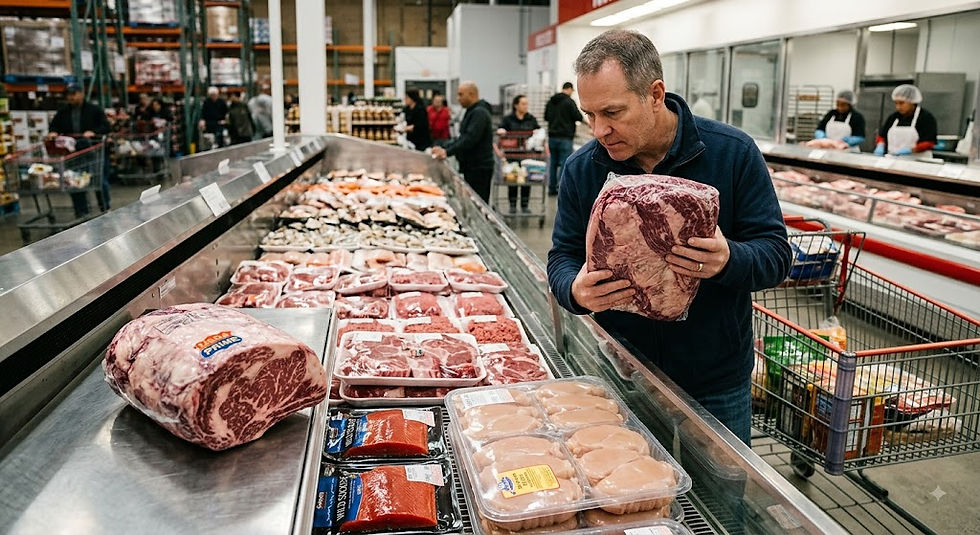
For a Prime-grade steakhouse experience at home without the $75-per-plate bill, Costco's meat case is the ultimate carnivore budget-flex.
That description — from the member community's extended experience with Costco's meat department — captures the specific commercial opportunity that the warehouse's protein section delivers in 2026: USDA Prime beef at institutional pricing that most steakhouses pay their suppliers, wild-caught salmon at per-pound pricing that makes restaurant salmon seem commercially irrational, and the complete range of proteins from bulk boneless chicken through whole brisket in the format and quality that serious home cooks choose specifically.
Compared to other major grocery store chains, Costco's beef quality is consistently higher — and the prices are often better too. This combination — better quality at better pricing — is the institutional result of Costco's limited SKU model applied to the protein category: fewer cuts, higher volume per cut, better supplier relationships, and a quality standard that extends through the Kirkland Signature private label into every product in the meat department.
This guide covers the complete 2026 Costco meat and seafood picture — organized by protein category, with the specific cuts that deliver the best value and quality, the specific products to approach with more caution, the pricing context, and the practical cooking guidance that makes each cut genuinely excellent.
The Beef Category: USDA Prime at Institutional Pricing
The USDA Grade Distinction: Why Prime Matters at Costco
USDA Prime is the top 2 percent of all graded beef in the United States — the designation that communicates the highest level of intramuscular fat marbling that produces the buttery tenderness and rich flavor that distinguishes genuinely excellent beef from the Choice and Select grades that conventional grocery stores primarily sell.
Most grocery stores do not stock USDA Prime beef. The per-pound cost of Prime beef at specialty butcher shops and high-end grocery stores is $30 to $60 for premium cuts. Costco stocks USDA Prime beef and prices it at institutional markup rather than specialty retail markup — creating the specific commercial opportunity that the member community describes as steakhouse quality without the steakhouse bill.
Prime Ribeye — The Crown Jewel of the Costco Meat Case
The USDA Prime whole ribeye roast at Costco is, by consistent member and food community consensus, one of the single most extraordinary value propositions in American retail. Reddit enthusiasts call it meat candy. The intramuscular fat marbling in the Prime grade delivers a rich, nutty flavor that Choice cuts simply can't touch.
The specific preparation recommendation that the food community has coalesced around: reverse-sear in a 250°F oven to 115°F internal temperature, then finish in a screaming-hot cast iron skillet with butter, garlic, and thyme. The reverse-sear method produces edge-to-edge medium-rare doneness that direct-sear methods cannot match — and it is particularly important for a ribeye this quality, where the cooking method either showcases or undermines the marbling.
At Costco's institutional pricing per pound, the Prime ribeye is available at a price that makes serving steakhouse-quality ribeye at home for a family of four financially comparable to takeout pizza rather than a special-occasion restaurant bill.
Prime New York Strip
The Prime upgrade matters more on strip than on most cuts. Choice strip can be lean and chewy; Prime adds the marbling that turns a $14 cut into a steakhouse-quality dinner. Cheaper than Prime ribeye, every bit as satisfying when cooked right.
The cooking method: grill over direct high heat 4 minutes per side for medium-rare. The strip's denser muscle structure makes it the steak that benefits most from high heat — the sear crust that high heat creates contrasts with the tender interior in the way that strip specifically rewards.
Flat Iron Steak — The 2026 Addition
The flat iron steak made its first appearance in some Costco locations in early 2026 — a development that the meat enthusiast community noted with particular enthusiasm. The flat iron — cut from the shoulder blade — is one of the most flavorful and most tender cuts in the entire beef animal, second only to the tenderloin in tenderness among all cuts. Its relative obscurity (compared to ribeye and strip) has historically kept its per-pound price lower than its quality justifies.
At Costco's institutional pricing, the flat iron is the specific steak discovery for members who want tenderloin-adjacent tenderness at a per-pound price meaningfully below the premium cuts — and the 2026 availability represents an addition worth checking for at the local warehouse's meat case.
USDA Prime Brisket — The Pellet Smoker's Essential
The USDA Prime whole packer brisket is the cut that made the Costco meat department famous in the barbecue community — and the reason that every serious home smoker considers a Costco membership an essential tool in their outdoor cooking kit.
A whole packer brisket — the point and flat together — at Prime grade from a specialty butcher costs $5 to $9 per pound. Costco's institutional pricing on the same USDA Prime whole brisket consistently undercuts this range, producing a total brisket cost of $35 to $65 depending on the weight — for the cut that serves 20 to 30 people from a single properly smoked preparation.
USDA Choice Boneless Ribeye and Shoulder Roasts
For members who want the ribeye eating experience without the Prime price point — or who are cooking for a larger group where the per-person cost of Prime becomes a factor — the USDA Choice boneless ribeye and shoulder roasts at Costco deliver the next tier of quality at institutional pricing.
What to Skip: The Beef Category Cautions
Individual portion-cut steaks that are priced by the pack rather than by the pound require careful math — the total package price can make it difficult to calculate the per-pound cost that is the relevant comparison metric. Members evaluating any single steak purchase at Costco should calculate the per-pound cost before adding to the cart.
The .97 price ending on any meat item — which communicates clearance status — is worth approaching with additional scrutiny. A clearance-priced meat item is nearing the end of its quality window at the warehouse. It is not necessarily poor quality, but the member should have a cooking plan for immediate use rather than freezer storage.
The Chicken Category: The Everyday Protein at Institutional Pricing
Kirkland Signature Boneless Skinless Chicken Breasts — Saddle Pack
The boneless skinless chicken breast at Costco in the saddle-pack format — where each breast is individually vacuum-sealed within the larger package, allowing individual freezing without additional portioning — is the most consistently recommended chicken purchase in the warehouse.
The saddle-pack format's specific practical advantage: a family that buys a 6-pound package of Costco chicken breasts can freeze each breast individually without any additional work — thawing exactly the quantity needed for each dinner preparation rather than managing the partial-package-in-the-freezer situation that non-saddle-pack chicken creates.
The per-pound pricing on Costco boneless chicken breasts is consistently among the lowest available in any retail channel — typically $3.00 to $4.00 per pound versus $5.00 to $7.00 per pound at a conventional grocery store for comparable quality.
Ground Turkey and Ground Beef
Ground turkey at Costco — in the 3-pound or larger format — delivers at per-pound pricing below what comparable quality ground turkey costs at grocery stores. For households that use ground turkey for weeknight meal prep (turkey tacos, turkey meatballs, turkey bolognese), the Costco format and pricing make weekly ground turkey use financially trivial.
Ground beef at Costco — 80/20 for burgers, 85/15 or 90/10 for sauces and mixed preparations — appears at per-pound pricing that is consistently competitive with or below grocery store alternatives at the same fat content tier.
Rotisserie Chicken — The Institution
The $4.99 Kirkland Signature Rotisserie Chicken — covered extensively in its own dedicated guide — is referenced here only to complete the chicken category picture: it remains the single most iconic and most financially extraordinary chicken purchase in American retail.
The Pork Category: Weekend Cooking Value
Pork Tenderloin
The pork tenderloin at Costco — one of the leanest and most versatile proteins in the fresh meat case — appears in multi-loin packages at institutional per-pound pricing. For the household that uses pork tenderloin for quick weeknight dinners (20 minutes to properly cooked at high heat), the Costco format delivers the leanest, most adaptable fresh pork protein at the best available pricing.
Pork Shoulder/Boston Butt
The pork shoulder or Boston butt — the cut of choice for pulled pork, carnitas, and low-and-slow pork preparations — at Costco provides the generous weight and institutional per-pound pricing that makes a full pulled pork cook for a large group financially manageable. A 7 to 10 pound pork shoulder at Costco feeds a gathering of 15 to 20 people with appropriately portioned pulled pork at a total protein cost that is dramatically below what the same quantity would cost at a catering company or restaurant.
St. Louis Style Ribs and Baby Back Ribs
Pre-trimmed pork ribs at Costco — the St. Louis trim that removes the cartilage and excess fat without requiring the home cook to do the butchery — appear at institutional per-pound pricing with the specific labor-already-done advantage that makes them the preferred rib purchase for the pellet smoker owner who wants to focus on the smoke and the sauce rather than the butchery preparation.
The Seafood Category: Wild vs. Farm-Raised and the Quality Hierarchy
Wild-Caught vs. Farm-Raised: The Essential Distinction
The average cost of wild-caught fish at Costco is $14.24 per pound — reflecting the genuine cost difference between wild-caught and farm-raised seafood. This price differential communicates something real about the product: wild-caught fish have different nutritional profiles (typically higher omega-3 content, different flavor characteristics) than farm-raised alternatives.
The practical guidance: for the health-conscious seafood consumer who is specifically buying fish for its omega-3 fatty acid content — the cardiovascular and anti-inflammatory benefit that makes fatty fish the most recommended protein in clinical nutrition — wild-caught is the specification that matters. For the consumer who is primarily optimizing for cost and protein content, farm-raised provides comparable protein at lower per-pound cost.
Kirkland Signature Wild Alaskan Sockeye Salmon — The Premier Seafood Purchase
The individually vacuum-sealed Kirkland Signature Wild Alaskan Sockeye Salmon — available in both fresh and frozen configurations — is the seafood purchase that generates the strongest sustained member enthusiasm of any protein in the Costco lineup.
The Sockeye is harvested in the United States — a specific provenance that matters both for quality (Alaskan wild salmon is held to higher sustainability and quality standards than comparable international sources) and for the specific flavor profile that distinguishes Sockeye from Atlantic farm-raised alternatives.
Sockeye's strong flavor and deep reddish color communicate the specific characteristics of truly wild salmon rather than the pale pink, mild-flavored farm-raised product that dominates conventional grocery store seafood counters.
The frozen individual portion format means the salmon cooks directly from the freezer — no thawing required, no planning required, air fryer at 400°F for 12 minutes from frozen to perfectly cooked salmon. For the household that wants to cook salmon twice per week without the planning pressure that fresh fish creates, the frozen individual portions are the specific format that makes this possible.
Kirkland Signature Farm-Raised Shrimp
The 2-pound bag of Kirkland Signature Farm-Raised Shrimp — 21 to 25 count per pound, tail-on — is the seafood protein that delivers the highest protein-to-calorie ratio of any whole food in the Costco protein section. The 21-25 count designation communicates a large shrimp — larger than the 31-40 count shrimp that many grocery stores sell as "large" — and the tail-on format provides the visual presentation that makes shrimp dishes genuinely impressive.
The farm-raised designation is appropriate here: farm-raised shrimp's lower per-pound cost (well below the wild-caught average of $14.24) makes it the practical everyday protein rather than the occasional treat that wild-caught shrimp pricing creates. The nutritional difference between wild and farm-raised shrimp is minimal — shrimp's nutritional value is primarily in its complete protein content, not in its fatty acid profile.
Kirkland Signature Albacore Tuna — The Pantry Protein
Already covered in the pantry staples guide — but worth restating in the seafood context: the Kirkland Signature Albacore Tuna in water, 7 ounces per can, 8-count, is the most cost-efficient complete protein available through any Costco channel.
Tilapia — The Caution
The community consensus on farmed tilapia at Costco is more divided than on any other seafood product in the lineup. Some reviewers describe it as fishy in a bad way — a criticism that is more about the species' delicacy and farming method vulnerability than about Costco's specific sourcing. For members who have had a positive tilapia experience at Costco, the pricing makes it the most economical fresh white fish available. For members who have found it to be off-putting in flavor, the skip recommendation applies consistently.
The Sub-Primal Buying Strategy: The Most Financially Advanced Approach
The cheapest way to buy steak at Costco is to buy uncut sub-primals or bulk steak packages — rather than individually cut steaks. These bulk packs lower the price per pound and let you cut or portion them yourself at home.
The sub-primal approach: Costco sells whole beef cuts — the prime rib roast, the whole tenderloin, the whole striploin — from which members can cut their own steaks at home. A whole prime rib roast at $14 to $17 per pound can yield individual ribeye steaks that would cost $25 to $35 per pound individually at a grocery store. The member who is comfortable with basic butchery — a sharp knife, a cutting board, and five minutes — captures this price differential on every pound of beef they cut.
The specific sub-primal purchases that are most rewarding for home butchery: the whole striploin (cut into New York strip steaks), the whole tenderloin (cut into filet mignon medallions), and the whole prime rib roast (cut into individual ribeye steaks or kept whole for a standing rib roast celebration dinner).
The Freezer Strategy: Getting Full Value from Bulk Protein
The most financially efficient approach to Costco protein purchasing assumes access to a dedicated chest freezer or a refrigerator with substantial freezer capacity — because the quantities that Costco's institutional format delivers are larger than most households consume within the fresh window.
The specific freezer strategy that maximizes Costco protein value:
Buy the boneless chicken breast saddle pack, freeze each individual breast in a labeled freezer bag, and thaw one breast per dinner preparation for the following three to four weeks.
Buy the 5-pound ground beef in the Costco format, portion into one-pound balls, freeze each individually, and thaw on the day needed for the specific recipe.
Buy the whole prime rib roast, cut into individual steaks at home, wrap each steak in plastic wrap and a freezer bag, and freeze for the weekend steak dinners across the following month.
Buy the frozen Wild Alaskan Salmon portions — which are already individually vacuum-sealed and cook from frozen — and store in the freezer without any additional preparation.
At MOJO Sales & Branding, we understand every dimension of the Costco member experience — from the meat and seafood case that delivers steakhouse quality at institutional pricing to the roadshow brands that create the discovery moments that make every warehouse visit genuinely exciting. Contact us at 732.433.7873 or Susan@MOJOSalesandBranding.com.
Costco Meat and Seafood 2026 — Best Buys Quick Reference:
Protein | Grade/Type | Why It Wins | Cooking Method |
Whole Prime Ribeye Roast | USDA Prime | Best marbling, steakhouse quality | Reverse sear, cast iron finish |
Prime New York Strip | USDA Prime | Prime adds marbling Choice lacks | Direct high heat grill |
Flat Iron Steak | USDA Choice | Tenderloin-adjacent tenderness | Grill or cast iron, medium-rare |
Whole Packer Brisket | USDA Prime | Barbecue essential at best price | 225°F low and slow, 12-18 hrs |
Boneless Chicken Breast | Saddle pack | Individual freeze format, best per-lb | Bake, grill, sauté from thawed |
St. Louis Ribs | Pre-trimmed | No butchery needed | 250°F smoker or grill, 4-6 hrs |
Pork Shoulder | Bulk | Feeds large groups, institutional price | 225°F low and slow, 8-12 hrs |
Kirkland Wild Sockeye Salmon | Wild Alaskan | Strongest omega-3, best flavor | Air fryer 400°F 12 min from frozen |
Farm-Raised Shrimp 2lb | 21-25 ct | Best protein-to-calorie ratio | Sauté 2 min per side |
Albacore Tuna 8-count | Canned | Most cost-efficient complete protein | Pantry stable, ready to eat |
#CostcoMeatSeafoodGuide2026 #CostcoMeat2026 #CostcoSeafood2026 #CostcoPrimeRibeye #CostcoUSDAP #CostcoBrisket2026 #CostcoSalmon2026 #CostcoChicken2026 #CostcoPorkRibs2026 #CostcoFlatIronSteak #CostcoSteaks2026 #CostcoShrimp2026 #CostcoProtein2026 #CostcoMember #CostcoLife #CostcoInsider #CostcoSavings2026 #CostcoTips #CostcoHacks2026 #MOJOSalesAndBranding


Comments